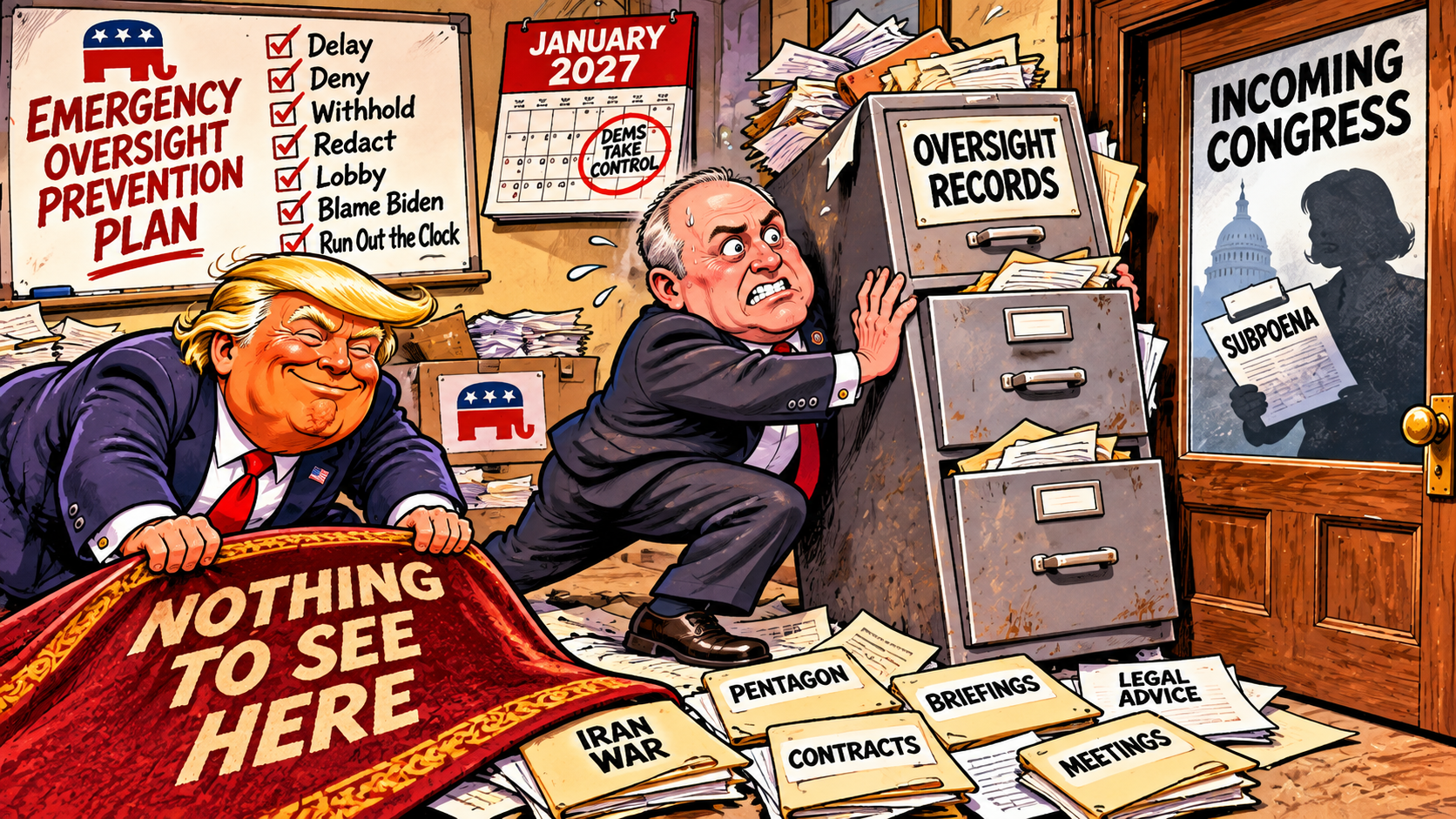
“Steve Scalise has a plan.”
That sentence alone should make anyone who has followed the Republican Party’s performance over the last two years a little nervous. But the House Majority Leader has apparently decided that the remaining weeks of Republican control of Congress should be devoted to preparing for the arrival of something the party has spent an extraordinary amount of time avoiding. Congressional oversight.
Yes, that congressional oversight. The kind involving questions, documents, subpoenas, sworn testimony, and the occasional unpleasant discovery that the Constitution contains provisions beyond the Second Amendment.
According to Fox News, Scalise sent a letter Thursday to Republican committee chairs instructing them to prepare for investigations by the incoming Democratic majority. His warning was predictably dramatic. Democrats, he said, would use their committee powers to pursue Trump, his family, Cabinet officials, and political allies.
Well, yes, Steve. That is generally what happens when Congress decides to investigate the conduct of an administration. The identity of the people being investigated tends to have some relationship to the identity of the people running the government. An unfortunate coincidence, I’m sure.
The Auditors Are Coming! The Auditors Are Coming!
Imagine, for a moment, that you own a business. Your accountant calls to inform you that the IRS has selected your company for an audit. You immediately summon your management team for an emergency meeting. “Folks, we’ve got a serious problem. The auditors are coming.”
“Have we done something wrong?”
“That’s beside the point.”
“Are our records in order?”
“Also beside the point.”
“Should we review the books?”
“Absolutely. But first, we need a comprehensive strategy for preventing the auditors from discovering anything that might make us look bad.”
Now, to be fair, there is nothing inherently improper about preparing for congressional investigations. Government officials have every reason to organize records, retain counsel when appropriate, and develop legitimate legal responses to investigative demands.
Congressional oversight can also be abused. A committee subpoena does not become legitimate merely because its recipient happens to be unpopular with the majority party.
But there is something revealing about the speed with which Republicans have discovered the dangers of aggressive oversight now that somebody else will be conducting it. For two years, the party controlled the House, the Senate, and the White House. During that period, Donald Trump pursued an expansive program of executive action, including controversial military operations, immigration enforcement measures, spending decisions, and business arrangements involving members of his family.
Many of those actions have generated substantial legal and constitutional questions. Congressional Republicans had the power to investigate them. Whoops, let me rephrase that. Congressional Republicans had a duty to investigate them. They also had the duty to ask questions, compel testimony, examine records, and determine whether the executive branch was acting within its lawful authority. And now, having lost their majorities, they appear deeply concerned that somebody might actually understand that duty.
The Constitution Apparently Survived Tuesday’s Election
Let’s revisit something that has become a recurring theme around here. The Constitution establishes three branches of government.
Congress makes laws, controls appropriations, exercises oversight, and possesses the impeachment power. The President exercises executive authority within constitutional and statutory limitations. The judiciary resolves cases and controversies within its jurisdiction.
There are complications, qualifications, and approximately two centuries of litigation concerning the boundaries between those powers. But the general arrangement is fairly straightforward. The legislative branch is supposed to provide an independent check on the executive. That responsibility does not evaporate when the President happens to belong to the same political party as the congressional majority, though it certainly feels that way as a practical matter.
Under Article I, Section 2, the House possesses the sole power of impeachment. The Senate has the sole power to try impeachments under Article I, Section 3. Congress also possesses broad investigative authority in support of its legislative responsibilities. The Supreme Court has long recognized that authority, while imposing constitutional limits on its exercise.
In Trump v. Mazars USA, LLP, the Supreme Court addressed congressional subpoenas seeking the President’s personal financial records and emphasized the need to account for separation-of-powers concerns when Congress seeks such material.
That case is a useful reminder that congressional oversight is governed by law. Committees must exercise their authority for legitimate purposes and respect applicable constitutional protections. There are procedures. There are limits. There are remedies for unlawful demands.
What the Constitution does not provide is a general exemption from scrutiny for government officials whose political party recently lost an election. Someone may want to tell Steve.
Two Years of Questions. Two Months to Prepare the Answers.
The Associated Press reports that Democrats are preparing extensive investigations into allegations involving Trump family business interests, cryptocurrency ventures, federal contracts, government construction projects, immigration enforcement, and the administration’s handling of the Jeffrey Epstein investigation.
The White House denies wrongdoing and characterizes the proposed investigations as politically motivated. Fair enough. Those are positions the administration is entitled to advance. But allegations of misconduct require examination before anyone can responsibly determine whether they are substantiated.
That examination becomes particularly important when the allegations concern the use of public office for private financial benefit, the expenditure of public money, or the exercise of governmental authority against individuals.
According to the AP, incoming Democratic committee leaders have already identified numerous investigative priorities. Representative Robert Garcia, the ranking Democrat on the House Oversight Committee, offered a particularly concise assessment of what the election results mean for officials anticipating scrutiny.
“Lawyer up.”
Somewhere in Washington, a thousand attorneys just heard the unmistakable sound of billable hours approaching. And while we appreciate the economic stimulus to the legal profession, there is a considerably more important issue at stake. The American people are entitled to know whether their government has been operating lawfully.
The answer should come from documents, testimony, and evidence. If the allegations prove unfounded, the record should establish that. If they prove substantiated, Congress should determine what remedies are appropriate.
And if those findings establish conduct constituting high crimes and misdemeanors (beyond those we already advocate exist), the Constitution supplies a mechanism for addressing it. We have mentioned that mechanism once or twice, and will likely be mentioning it again…and again…and, well, you get the point.
Impeachment Is Supposed to Follow the Evidence
There is an important distinction between investigating conduct that may warrant impeachment and deciding in advance that impeachment must occur regardless of what the evidence establishes.
While we believe, in many ways, grounds have already been established for many of the reasons we have discussed, the latter would make for a particularly lousy congressional investigation.
It would also hand Trump the exact argument he has relied upon throughout his political career: that every inquiry into his conduct is merely an effort by political opponents to destroy him. That argument has proved remarkably effective with his supporters, waning, wary and weakened as they may be.
It should become considerably less effective when Congress conducts thorough investigations, develops an evidentiary record, affords appropriate procedural protections, and explains its findings in terms ordinary Americans can understand. The incoming majority should remember that.
Hakeem Jeffries has not ruled out a third impeachment. His party’s prospective committee chairs are preparing investigations across multiple areas of the administration. Great.
But congressional Democrats should resist the temptation to turn every committee hearing into a televised competition over who can deliver the most dramatic speech.
There will be ample opportunity for speeches. Start with the records. Identify the decision-makers. Establish the chronology. Examine the asserted legal authority. Determine what the officials knew, when they knew it, and what they did afterward. Then make the case.
If the evidence supports additional impeachment articles (we will continue to discuss the ones we believe are already founded and sustainable as we sit here today), introduce the articles and explain precisely why the conduct satisfies the constitutional standard. And if it does not, say so. An investigation that produces an inconvenient answer is still an investigation worth conducting.
The Republican Party Has an Opportunity Here, Too
There is another reason this development matters. Republicans have just suffered a substantial electoral defeat. According to Reuters, party officials and strategists are already urging Trump to change direction, reconsider personnel, and address policies they believe contributed to the losses. Even JD Vance has reportedly identified the Iran war as a factor in the party’s electoral troubles. That is a little like sending a baby shower gift to a kindergarten graduation ceremony, but better late than never, we suppose.
The Vice President, whose political future depends in considerable part upon what happens to the Republican Party after Trump, appears to understand that the administration’s decisions have consequences extending beyond the next presidential press conference. He may also be discovering that defending every presidential decision becomes somewhat less appealing when the President’s political fortunes begin deteriorating. And as Tuesday would indicate, that process is already well on its way.
We welcome you to the concept of independent judgment, Mr. Vice President. We have been expecting you for a while now. You took a wrong turn somewhere between your private admissions that “Trump is America’s Hitler” and where we are today, but you’ve arrived.
Republicans now have an opportunity to demonstrate that their commitment to constitutional government extends beyond protecting whichever member of their party happens to occupy the Oval Office. They could cooperate with legitimate investigations.
They could insist that administration officials provide truthful testimony. They could examine the evidence and make independent judgments about misconduct. They could even acknowledge that a Republican president is capable of violating the law. We’re not holding our breath either, but they could.
If the evidence ultimately establishes further impeachable conduct by Donald Trump, Republican members of Congress will have to decide whether their constitutional obligations are more important than their loyalty to him. For the sake of the party’s long-term survival, that decision deserves serious consideration, because if we are to take anything from Tuesday’s election night, it could be that voters have already made that determination.
…and on that Note
There is something else Scalise and his colleagues might consider.
Tuesday’s election happened.
Democrats won control of both chambers of Congress. The electorate changed the political composition of the legislative branch, giving the incoming majority the institutional authority that accompanies those victories. Voters did so amid widespread concerns about corruption, affordability, and the state of American democracy.
According to the Associated Press Voter Poll, approximately half of voters considered government corruption crucial to their congressional vote. That does not establish that every voter supports impeachment. It certainly does not establish that the electorate has endorsed every proposal congressional Democrats intend to advance.
But it does suggest that questions about the conduct of government officials played a substantial role in the election. And the incoming Congress has every reason to take those concerns seriously. Republicans can criticize the investigations. They can challenge improper subpoenas, dispute allegations, and defend their records.
They can even make a persuasive case that particular investigations are politically motivated. They have been making that case about virtually every other investigation, and it would be naive to think they would stop now. It’s hard to quit shouting “PoLiTiCaLLy MoTiVaTeD” cold turkey. What they should have considerably more difficulty explaining is why the prospect of congressional oversight has become an emergency requiring a coordinated political defense.
After all, if the administration’s conduct has been lawful and proper, establishing that fact should be in everyone’s interest. Including theirs.
Steve, We Have Some Bad News
The incoming Democratic Congress is going to investigate Donald Trump. It will investigate members of his administration. It will examine allegations concerning public expenditures, private business interests, executive authority, and the conduct of federal agencies. It will because it should!
Some investigations may produce substantial evidence of wrongdoing. Others may produce little. Some may uncover conduct that is politically embarrassing but perfectly lawful. That is how investigations typically work.
And the fact that Republican leadership is preparing to fight them before the new Congress has even convened tells us something about the political atmosphere awaiting Washington in January. The constitutional question is whether Congress will exercise its powers responsibly and whether the executive branch will comply with lawful demands.
The political question is whether Republicans will continue treating accountability as a partisan threat. If past is prologue, those questions will eventually converge. Because the evidence Congress develops could provide additional grounds for impeachment proceedings, not just against Trump or Hegseth, but against officials whose conduct warrants them.
And if that happens, the Republican Party will face a choice that no amount of advance planning by Steve Scalise can eliminate. The Constitution or Donald Trump. If history were the sole indicator of how we answer that, both Trump and Steve would have very little to worry about. But if we learned anything from Tuesday, it is that the electorate may not be as receptive to such an answer.
The voters have already changed Congress.
Now Congress gets to examine the administration.
Steve, you might want to make sure the books are in order.
The Removal Advance is an independent political commentary and satire publication. This article expresses the opinion of its Editorial Board. Allegations of wrongdoing discussed herein have not been established merely by their inclusion in proposed congressional investigations.