In 1868, Congress put a president on trial and discovered something the Constitution’s authors already knew: impeachment is a political judgment, and the law cannot make that judgment for us.
In 1868, the United States Senate came within one vote of removing a president from office. Andrew Johnson had been impeached by the House of Representatives, eleven articles had been adopted, and the Senate had spent weeks hearing evidence about whether the nation’s chief executive should remain in the White House. Thirty-five senators voted to convict. Nineteen voted to acquit. Johnson survived because the Constitution required two-thirds of the senators present, and thirty-five was one vote short.
That is the sort of arithmetic that makes constitutional history so entertaining. A president can lose the support of nearly two-thirds of the Senate and still win the trial. There is no consolation prize for the majority, no recount that changes the constitutional threshold, and no appellate court waiting to decide whether the senators got it right.
The episode offers a lesson repeatedly obscured by the language of criminal law: impeachment is a political process. The Constitution deliberately entrusted it to Congress, where questions of public trust, presidential misconduct, institutional responsibility, and political judgment must be resolved by elected representatives.
Andrew Johnson’s experience shows both why the Framers designed it that way and how difficult they made its successful use.
A President at War With Reconstruction
Andrew Johnson inherited the presidency following Abraham Lincoln’s assassination in April 1865. The Civil War had ended, slavery had been abolished, and the country faced the enormous task of rebuilding the former Confederate states while determining whether millions of formerly enslaved Americans would enjoy meaningful citizenship and political rights.
Johnson favored a comparatively lenient restoration of the former Confederate states and resisted congressional efforts to protect the rights of freedpeople. He vetoed major Reconstruction legislation, including measures intended to strengthen the Freedmen’s Bureau and establish federal civil rights protections. Congress, increasingly dominated by Republicans determined to pursue a more sweeping Reconstruction, repeatedly challenged him.
These were disputes over the future of the republic, the authority of the federal government, and the meaning of freedom after slavery. They were also disputes between two branches of government, each claiming constitutional authority to determine the direction of Reconstruction.
Johnson was particularly determined to remove Secretary of War Edwin Stanton, a Lincoln appointee who supported congressional Reconstruction. Congress had passed the Tenure of Office Act in 1867, over Johnson’s veto, restricting the president’s ability to remove certain federal officers without Senate approval. Johnson considered the law an unconstitutional intrusion on presidential authority.
In February 1868, he ordered Stanton removed and attempted to replace him with Lorenzo Thomas. Stanton refused to surrender the office, and Congress treated Johnson’s action as a direct challenge to federal law and legislative authority.
The resulting spectacle involved competing claims to the War Department, an attempted transfer of authority, and Stanton’s determination to remain at his post. Washington had managed to turn a cabinet dismissal into a constitutional crisis with the added inconvenience of two men claiming the same office.
On February 24, the House voted 126 to 47 to impeach Johnson.
Eleven Articles and One Constitution
The House eventually adopted eleven articles of impeachment. Most concerned Johnson’s attempted removal of Stanton, his appointment of Thomas, and alleged violations of the Tenure of Office Act. Other articles addressed his efforts to circumvent congressional control over military administration and his public attacks on Congress.
One article accused Johnson of delivering inflammatory speeches that brought the presidency into disrepute. Another charged that he had challenged the legitimacy and authority of the Congress itself.
The charges therefore went beyond a simple question of whether Johnson had violated a statute. Congress was confronting a president who had resisted its Reconstruction program, challenged its authority, and tested the boundaries of executive power.
But Johnson’s defenders had constitutional arguments of their own. They questioned whether the Tenure of Office Act was constitutional, whether it applied to Stanton, and whether Congress could properly remove a president over a dispute concerning executive authority.
Those questions mattered. Impeachment cannot sensibly be understood as a license to remove a president merely because Congress dislikes his policies. The Framers created separate branches precisely because disagreement between them was inevitable.
The difficulty was deciding when disagreement became an abuse of public trust serious enough to justify removal.
The Constitution supplied a standard: treason, bribery, or other high crimes and misdemeanors. It did not provide a criminal code explaining every possible application of that standard. Nor did it establish a federal court to issue binding rulings on the merits of presidential impeachments.
Instead, it gave the House the sole power of impeachment and the Senate the sole power to try impeachments.
For the explanation, we can turn to a man who understood political conflict rather well.
Alexander Hamilton Had Already Explained This
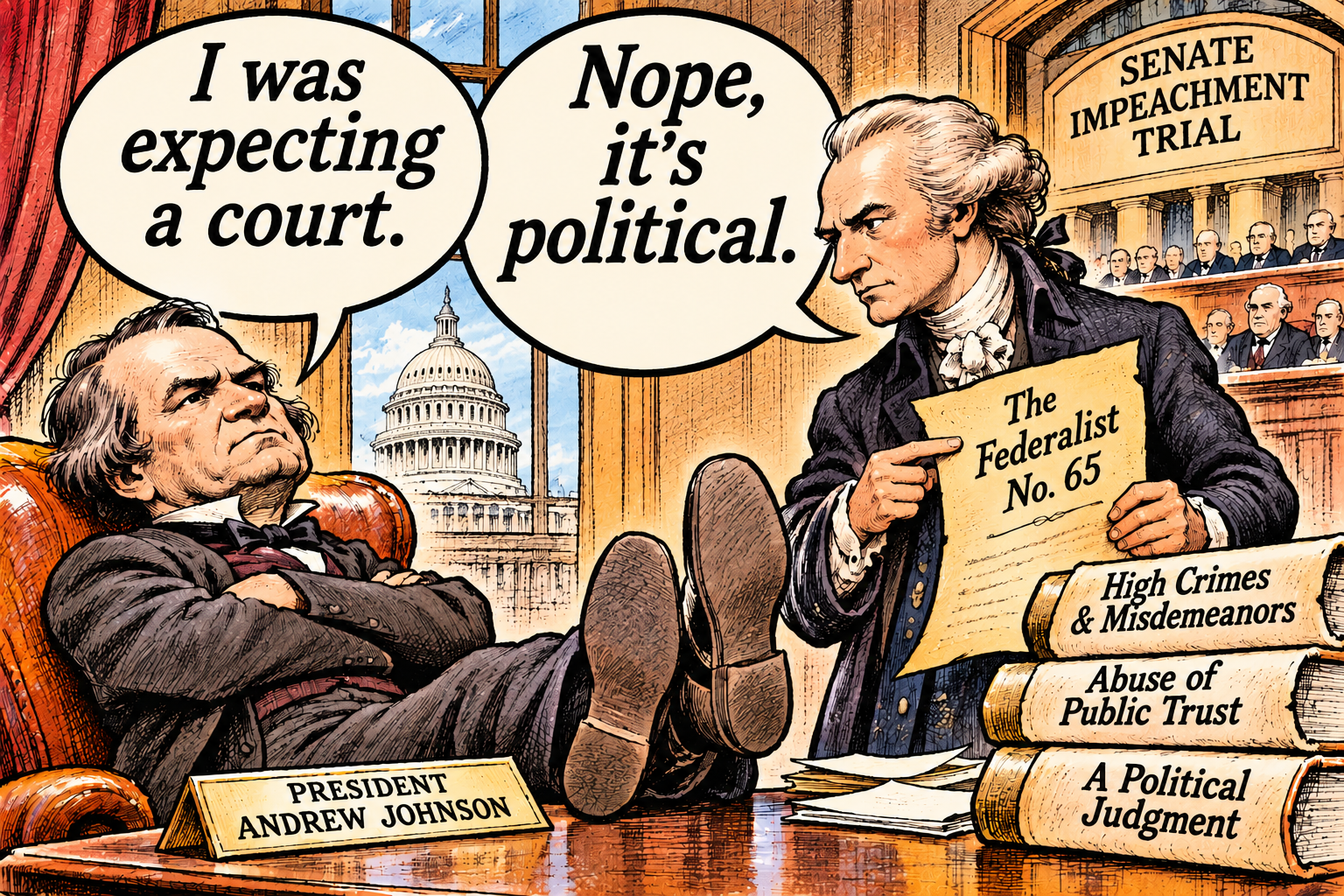
In Federalist No. 65, published in 1788, Alexander Hamilton described impeachable offenses as arising from the misconduct of public officials and the abuse or violation of public trust. He wrote that such offenses could properly be called “POLITICAL” because they involved injuries to society itself.
Hamilton’s choice of word was deliberate. The offenses were political because they concerned the exercise of public power and the responsibilities of public office. A president could commit an impeachable abuse without necessarily violating a criminal statute. Conversely, a criminal offense would not automatically answer every constitutional question about removal.
Hamilton also understood the danger of placing this responsibility in political hands. Impeachments would stir public passions, divide citizens into factions, and invite decisions influenced by party loyalty rather than the evidence.
He was describing the institutional problem, not endorsing partisan misconduct.
The Framers nevertheless assigned impeachment to Congress because the judgment involved the relationship between government and the governed. Whether an official had so abused the public trust as to warrant removal was a constitutional responsibility that the political branches would have to discharge.
This is the distinction worth remembering whenever someone insists that impeachment must await a criminal conviction.
A grand jury may determine whether there is sufficient evidence to charge a crime. A criminal jury may determine whether the government has proved guilt beyond a reasonable doubt. Congress must decide whether conduct satisfies the constitutional grounds for impeachment and whether removal is warranted.
Those inquiries can overlap, but they serve different purposes.
The Constitution makes the separation explicit. A judgment in an impeachment case can remove an official and disqualify that person from future federal office. Criminal prosecution, with its separate rules and penalties, remains available afterward.
The Senate does not sentence a convicted president to prison. It removes him from the presidency. The distinction is especially important because, in the American constitutional system, those are very different kinds of punishment.
The Vote That Saved Johnson
Johnson’s trial began in March 1868, with Chief Justice Salmon P. Chase presiding. The proceedings featured prominent lawyers, witness testimony, extensive argument, and enormous public interest.
The Senate voted first on Article XI, a broad charge concerning Johnson’s challenges to congressional authority and his efforts to obstruct Reconstruction legislation. On May 16, thirty-five senators voted guilty and nineteen voted not guilty.
The two-thirds requirement meant thirty-six votes were necessary.
Ten days later, the Senate returned identical results on Articles II and III. The remaining articles were never put to a final vote. Johnson was acquitted and remained in office.
Seven Republican senators had joined Democrats in voting against conviction. Their reasons varied, but concerns about the constitutional balance between Congress and the presidency were central to the opposition.
A senator could strongly oppose Johnson’s policies, deplore his conduct, and still conclude that the constitutional standard for removal had not been satisfied. Another senator could regard the president’s sustained resistance to Reconstruction and congressional authority as an abuse of public trust requiring his removal.
The Constitution entrusted that judgment to the Senate, subject to a demanding supermajority requirement.
There was no legal appeal to resolve the disagreement. Johnson remained president because the required number of senators had not voted to convict him.
The result also illustrates why describing impeachment as political requires care. Political judgment is not synonymous with unlimited discretion. Senators take an oath or affirmation when sitting for impeachment, and they are bound to apply the Constitution. The process demands constitutional reasoning even though its final decision belongs to a political institution.
The Court Is Not Waiting in the Wings
More than a century after Johnson’s trial, the Supreme Court addressed the judiciary’s role in impeachment proceedings.
In Nixon v. United States (1993), a case involving the impeachment of federal judge Walter Nixon rather than President Richard Nixon, the Court held that a challenge to the Senate’s procedures for trying an impeachment presented a nonjusticiable political question.
The Constitution’s assignment of the “sole Power to try all Impeachments” to the Senate was central to the decision.
The ruling did not establish that Congress could disregard every express constitutional requirement. It did confirm the broad authority of the Senate over the conduct of impeachment trials and the judiciary’s limited role in reviewing those proceedings.
That arrangement has consequences. Congress cannot hand the ultimate question to the Supreme Court whenever the evidence becomes difficult or the politics become uncomfortable. The responsibility belongs to the institution to which the Constitution assigned it.
And the public cannot reasonably expect a criminal verdict to answer every question that impeachment was designed to address.
A president may be criminally prosecuted for conduct that violates federal law. Congress may separately examine whether presidential conduct constitutes an impeachable abuse of public trust. The existence or absence of one proceeding does not automatically determine the result of the other.
The Lesson of 1868
Andrew Johnson’s impeachment is sometimes reduced to a story about a president who survived by one vote. That makes for excellent trivia and incomplete constitutional history.
The larger story concerns a country struggling to define the meaning of freedom after the Civil War, a president resisting congressional Reconstruction, and a legislature attempting to determine whether that resistance had crossed the constitutional threshold for removal.
The senators who voted to acquit did not establish that Johnson’s Reconstruction policies were correct. The senators who voted to convict did not need a criminal court to authorize their constitutional judgment. Both sides were operating within a system that deliberately placed the decision in Congress.
That system imposes an uncomfortable responsibility on elected officials. They must distinguish political disagreement from impeachable misconduct, apply constitutional standards to contested facts, and decide whether the abuse of public trust justifies removal. They must do so knowing that their own party loyalties may compromise the judgment the Constitution requires.
Hamilton understood the danger before the first president ever took office. Johnson demonstrated it eighty years later.
The Constitution gives Congress the authority to make that decision. It also makes Congress accountable for making it.
Andrew Johnson survived his impeachment by one vote. The constitutional responsibility that produced that vote has survived every presidency since.
And no one has yet discovered a way to make thirty-five equal thirty-six.