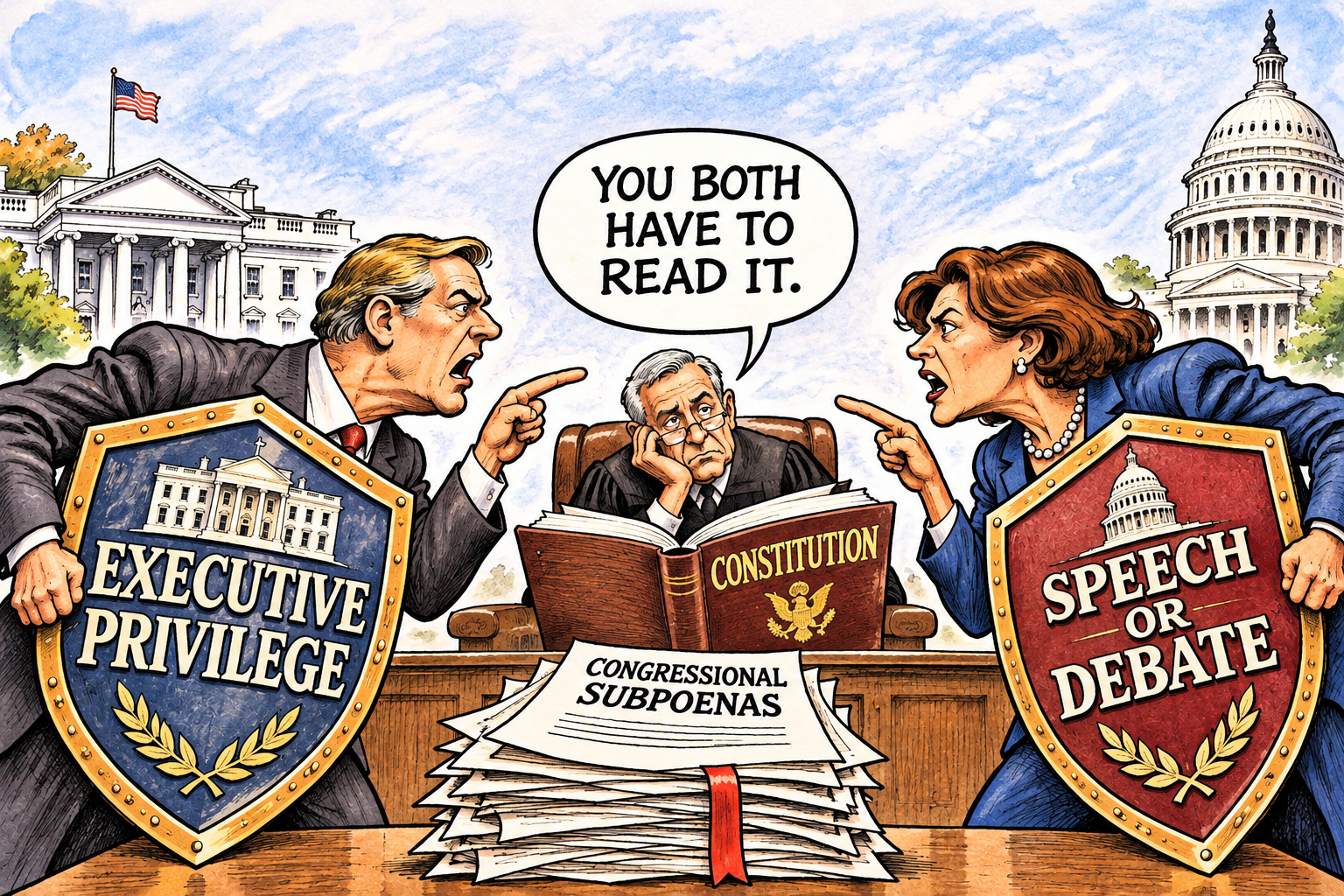
Executive privilege, the Speech or Debate Clause, and the constitutional limits of presidential resistance to congressional oversight.
The Trump White House has warned congressional Democrats that their plans to investigate the administration could expose them to criminal investigation. The warning came in a November 9 letter from White House counsel Will Scharf to Representative Robert Garcia, who is preparing to lead the House Oversight Committee in the next Congress.
Scharf’s letter raises legitimate questions about the scope of congressional investigative authority. Congress must pursue a valid legislative purpose when exercising its oversight powers, and the Supreme Court has repeatedly recognized limits on those powers. But the suggestion that congressional investigators could themselves face criminal scrutiny raises an additional constitutional question that deserves considerably more attention than it has received.
What happens when the executive branch threatens to investigate legislators for conducting investigations?
The answer begins with two constitutional protections that are frequently discussed separately: executive privilege and the Speech or Debate Clause. Their origins, purposes, and limits differ, but both concern the independence of the branches of government.
The President’s Privilege
Executive privilege serves an important constitutional function. Presidents need candid advice from their advisers, and confidentiality can be essential to effective decision-making. The Supreme Court recognized the constitutional basis for presidential communications privilege in United States v. Nixon, the 1974 case that ultimately required President Richard Nixon to surrender tape recordings sought in a criminal prosecution.
Nixon’s lawyers argued that the president’s interest in confidential communications justified withholding the recordings. The Supreme Court acknowledged that interest but concluded that a generalized assertion of privilege could not overcome the demonstrated need for evidence in the pending criminal proceeding.
Nixon turned over the tapes and resigned shortly thereafter. Executive privilege survived his presidency, although Nixon’s particular understanding of it did not fare nearly as well.
Disputes involving congressional subpoenas present additional considerations. The executive and legislative branches have competing institutional interests, and courts have often encouraged negotiated accommodations before resolving such disputes. A president may assert privilege over qualifying communications, challenge an overbroad subpoena, or object to an investigation that exceeds Congress’s constitutional authority.
Those protections have limits. The scope of executive privilege depends on the communications involved and the interests asserted. Its existence does not give the president unilateral authority to determine what Congress may investigate.
That brings us to a constitutional protection that receives considerably less attention in presidential press releases.
The Speech or Debate Clause
Article I, Section 6 of the Constitution provides that members of Congress, for speech or debate in either House, “shall not be questioned in any other Place.”
The Supreme Court has interpreted the Clause to protect legitimate legislative acts beyond speeches delivered on the House or Senate floor. The protection can extend to committee proceedings, legislative investigations, and subpoenas issued within the legitimate legislative sphere.
In Eastland v. United States Servicemen’s Fund, the Court held that the Speech or Debate Clause protected a Senate subcommittee’s subpoena issued as part of a legitimate legislative investigation. The Court emphasized the importance of preventing interference with Congress’s legislative functions.
The protection is substantial. When conduct falls within the legitimate legislative sphere, the Clause provides absolute immunity against being questioned elsewhere for that conduct. The protection applies even when critics allege improper legislative motives.
That last point matters in the present dispute.
The Clause does not immunize every activity undertaken by a member of Congress. Bribery, campaign activity, private misconduct, and other nonlegislative conduct remain outside its protection. In Gravel v. United States, the Court distinguished protected legislative activity from conduct outside the legislative process.
Congressional investigators therefore have constitutional protections, but those protections depend on the nature of their conduct.
A legislator’s participation in a legitimate committee investigation presents a different constitutional question from a legislator’s commission of an independently prosecutable offense.
The distinction becomes especially important when the executive branch suggests that congressional investigative activity itself could trigger criminal scrutiny.
The White House Letter
Scharf’s letter cites Watkins v. United States and Trump v. Mazars USA, LLP in support of the proposition that congressional investigations must serve legitimate legislative purposes.
Both decisions provide important guidance.
In Watkins, the Supreme Court emphasized that Congress’s investigative authority must relate to its legislative functions and respect constitutional limitations. In Mazars, the Court established a framework for evaluating congressional subpoenas seeking the president’s personal information, taking particular account of separation-of-powers concerns.
The White House can properly invoke these principles when challenging congressional demands for information.
The more difficult question arises from the letter’s suggestion that certain investigative activities could constitute criminal conduct.
The Speech or Debate Clause protects qualifying legislative acts against executive and judicial questioning. A congressional subpoena issued within the legitimate legislative sphere may therefore enjoy protection even when the executive branch disputes the committee’s motives.
The White House’s characterization of an investigation as politically motivated does not, by itself, defeat that protection. Conversely, calling an activity congressional oversight does not automatically establish that the activity falls within the Clause.
Determining the constitutional boundaries requires examining the actual conduct, the committee’s authority, and the legislative purposes involved.
These distinctions matter because the executive branch possesses substantial investigative and prosecutorial resources. The possibility of using those resources against legislators for protected legislative activity implicates the institutional independence the Speech or Debate Clause was designed to preserve.
The Framers apparently anticipated that members of Congress might occasionally irritate the president.
They provided accordingly.
The Impeachment Power
The dispute also implicates Congress’s impeachment responsibilities.
Article I assigns the House of Representatives the sole power of impeachment and the Senate the sole power to try impeachments. These powers provide a constitutional mechanism for examining alleged misconduct by federal officers, including the president, and determining whether impeachment and removal are warranted.
Investigations undertaken in connection with those responsibilities may raise questions distinct from ordinary legislative oversight. Their constitutional significance cannot be evaluated solely by applying principles governing routine requests for information.
A congressional investigation does not establish presidential misconduct. Nor does a dispute over a subpoena establish obstruction, abuse of power, or an impeachable offense. Such conclusions require evidence and careful evaluation of the relevant conduct.
But Congress must retain the ability to exercise its constitutional responsibilities without improper executive interference. The possibility of criminal scrutiny directed at protected legislative acts presents a serious separation-of-powers concern.
The question is particularly consequential when the subject of congressional oversight is the president himself.
A system that allowed the executive branch to suppress legitimate impeachment inquiries through threats of prosecution would fundamentally alter the balance of constitutional authority.
Whether any particular executive action crosses that boundary depends on the evidence. The constitutional principle deserves attention before the dispute reaches that point.
A Constitution for Both Branches
The president has legitimate constitutional interests in confidentiality and institutional independence. Congress has legitimate constitutional interests in conducting investigations and protecting its legislative processes from interference.
The Supreme Court has recognized both sets of interests, while establishing different legal protections and limitations for each.
The present dispute turns on the relationship between those protections. The executive branch may challenge investigations that exceed congressional authority. Congress may invoke the Speech or Debate Clause when executive action threatens protected legislative activity. Courts may be called upon to resolve particular disputes, although some conflicts between the branches are addressed through negotiation and political processes.
Scharf’s letter has placed these constitutional questions squarely in public view.
Its warnings about congressional authority deserve examination. So do the protections afforded to Congress when it exercises that authority.
The White House has every right to consult the Constitution when defending its institutional interests.
Congress has a copy, too.
Sources: White House counsel letter (Nov. 9, 2026); Associated Press (Nov. 11, 2026).